

A brief history of Porthcawl Railway
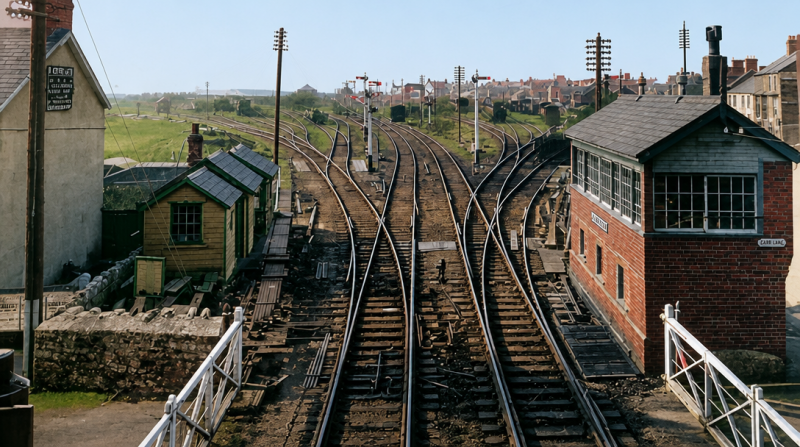
Porthcawl’s first railway was the 4 ft 7 in (1,397 mm)-gauge Duffryn Llynvi and Porthcawl Railway, a horse-drawn tramway. Construction began in 1825, and the line opened in 1829 with tram rails laid on stone sleepers. It was built to transport minerals from South Wales to Porthcawl harbour. It ran from Duffryn Llynfi, near Maesteg, via Tondu and Pyle, and was extended to Bridgend in 1834.
The South Wales Railway, which passed through Bridgend and Pyle, opened in 1850. In 1847, the Llynfi Valley Railway took over the original company and upgraded both former tramway branches. They reopened as broad-gauge railways on 10 August 1861. Porthcawl station opened on 1 August 1865. In 1866, the Llynfi Valley Railway merged with the Ogmore Valley Railway to form the Llynvi and Ogmore Railway.
Despite its conversion to a railway, trains on the Porthcawl branch continued to be horse-drawn until 1868, when the line was converted again to standard gauge. The Llynvi and Ogmore Railway was taken over by the Great Western Railway in 1873.
By the early 20th century, Porthcawl had become an important holiday destination. In 1916, the GWR rebuilt the station on a new site, a mile closer to the seafront. The new station was not universally popular, however. Its wooden and asbestos building was considered rather insubstantial, and although the original station had a footbridge, the GWR did not provide one at the new station despite increasing the number of platforms from two to three. Passengers using the more distant platforms had to make a lengthy detour via a link at the end of the platforms. A special gate at the end of the departure platform was provided for day-trippers.[3] The original station’s turntable was not replaced and remained derelict on the site for many years. Nevertheless, passenger numbers remained high in the decades after the new station opened, with around 70,000 passengers using it.